
Tankless water heaters offer significant advantages: 24-34% energy savings, 20+ year lifespans, and space-saving designs. However, they require substantial upfront investment ($1,400-$5,600 installed) and complex installation with potential plumbing or electrical upgrades. While they provide endless hot water and eliminate standby heat loss, they may struggle with simultaneous high-demand usage. The 8-12 year payback period means your household water usage patterns will determine if this modern technology truly delivers on its promises.
Key Takeaways
Pros and Cons of Tankless Water Heaters
- Tankless heaters provide 24-34% energy savings and last 20-30 years, though they require a substantial initial investment of $1,400-$5,600 installed.
- They deliver endless hot water on demand without standby heat loss, but may struggle with simultaneous high-demand usage.
- Installation is complex, often requiring gas line upgrades or electrical modifications, plus professional venting and adherence to building codes.
- Space-saving wall-mounted design offers a significant advantage over bulky traditional tanks for homes with limited space.
- Annual maintenance is essential, including professional servicing and regular filter cleaning, especially in hard water regions.
Understanding How Tankless Water Heaters Work
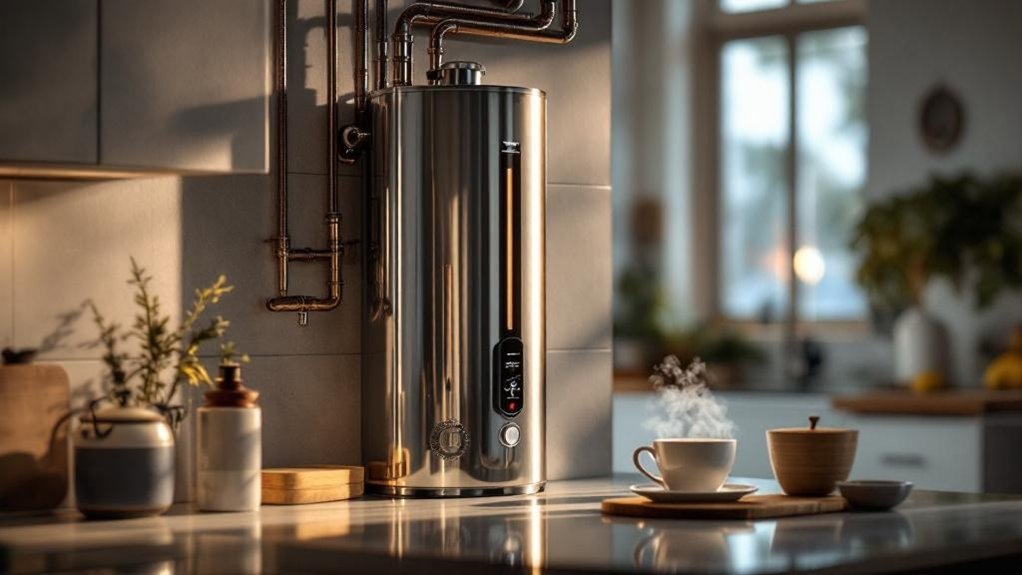
While traditional water heaters store and continuously heat gallons of water, tankless water heaters operate on a completely different principle. These innovative units provide hot water on demand through an efficient process that begins when you turn on your tap.
Here’s a functionality overview: When water flow is detected, sensors activate either electric heating elements or a gas burner. The water passes through a heat exchanger made of highly conductive materials like copper or stainless steel, which rapidly transfers heat to the water. Temperature sensors maintain your desired setting through a negative feedback system. Thermistors play a crucial role, detecting the flow and triggering the appropriate heating response.
The heating efficiency of tankless systems comes from their instantaneous operation. They only consume energy when hot water is needed, eliminating standby heat loss. This design delivers continuous hot water without the space requirements of traditional tanks, making them an excellent choice for many homes.
Key Benefits of Going Tankless
Homeowners considering a water heater upgrade should examine the substantial advantages that tankless models offer. At Pride Electric, we’ve seen firsthand how these systems transform households with their endless hot water supply—no more cold showers when you’re the last family member in line.
The energy savings are significant, with tankless units consuming 24-34% less energy than traditional tanks for average households. This efficiency translates directly to lower utility bills while reducing environmental impact.
We appreciate the space efficiency these compact, wall-mounted units provide, freeing up valuable floor area in tight utility closets. With a lifespan exceeding 20 years—nearly double that of conventional tanks—and minimal maintenance requirements, tankless systems represent both immediate comfort and long-term value for your home. Unlike traditional water heaters that need a dedicated space, tankless models can be wall-mounted in various locations throughout your home.
Potential Drawbacks to Consider
While tankless water heaters offer energy savings, they come with a considerably higher upfront cost for purchase and professional installation compared to traditional models. We’ve found that these systems have limited flow capacity, potentially struggling to meet simultaneous hot water demands from multiple appliances or fixtures in larger households. You’ll need to carefully assess whether the long-term efficiency benefits justify both the initial investment and the potential need for additional units to handle your home’s peak water usage. Installing in hard-water areas requires a water softener installation to prevent scale buildup that can reduce efficiency and lifespan.
Higher Initial Investment
Although tankless water heaters offer numerous benefits, they come with a markedly higher initial investment than traditional models. While standard tank heaters typically cost $400-$800, tankless units range from $500-$2,000, with installation adding another $1,000-$3,000.
These budget considerations can be significant for many homeowners. The total investment of $1,400-$5,600 depends on factors like brand, capacity, and fuel type—with gas models generally costing more than electric ones due to venting requirements. For tankless systems, installation costs are higher because they often require additional equipment or modifications to existing home systems. However, this expense should be viewed as a long-term investment. Many homeowners find that financing options help manage the upfront costs while still allowing them to benefit from the energy efficiency, space savings, and longer lifespan that tankless models provide.
Limited Flow Capacity
Beyond the initial cost considerations, one significant limitation of tankless water heaters is their restricted flow capacity. Most residential units deliver only 2-5 gallons per minute, which can be insufficient when multiple fixtures are running simultaneously.
This limitation creates real challenges for larger households. When someone’s showering and the dishwasher starts, you’ll likely experience temperature fluctuations or even cold water. Unlike traditional tanks that store hot water for multiple uses, tankless systems must heat water on demand with finite capacity. This issue highlights why tankless heaters are often not suitable for large homes with multiple simultaneous hot water needs.
Effective flow management becomes essential with these systems. Some practical usage strategies include staggering shower times, spacing out laundry and dishwashing, or installing multiple units strategically throughout your home. Low-flow fixtures can also help maximize the available capacity, especially for families where simultaneous hot water needs are common.
Cost Analysis: Initial Investment vs. Long-Term Savings
When considering a tankless water heater, understanding the cost equation becomes essential for making an informed decision. The initial investment ranges from $1,400-$5,600 installed, with most homeowners paying around $2,600.
Fuel cost greatly impacts both upfront and long-term expenses. Electric models typically cost less initially (around $2,500 installed), while gas units average $3,500-$4,000 due to increased installation complexity with venting requirements.
The long-term outlook is where tankless units shine. With 24%-34% greater energy efficiency, potential utility savings of $100-$200 annually, and a lifespan of 20+ years (compared to 10-15 for traditional tanks), the higher initial cost can be recovered within 8-12 years for high-usage homes. Installation may require additional modifications such as a larger gas line for gas-powered units. Factor in reduced water damage risk and potential resale value benefits for a complete financial picture.
Installation Requirements and Challenges
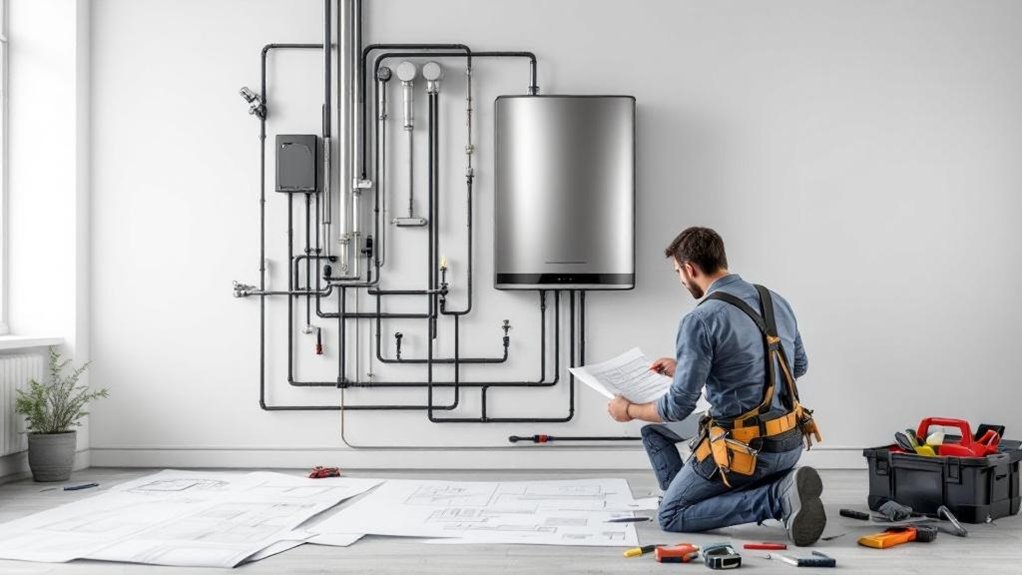
Installing a tankless water heater involves considerably more complexity than replacing a traditional tank model. We recommend considering several critical factors before proceeding with installation.
First, you’ll need to assess your installation space carefully. While tankless units are compact, they require proper clearances from combustible materials and accessibility for maintenance. Your gas lines may need upgrading to meet the higher BTU demands, and electrical systems must support the unit’s requirements. Always review product manual thoroughly before beginning any installation work.
Venting options present another challenge, as these systems require direct venting to the outside—not through existing chimneys. This often means cutting new holes through walls and installing specialized venting materials.
Before starting, check local building codes and obtain necessary permits. Many homeowners find that professional installation is worth the investment, considering the technical expertise required for safe, code-compliant installation.
Comparing Tankless to Traditional Tank Heaters
After understanding the complexities of installation, you’ll want to weigh how tankless water heaters stack up against their traditional tank counterparts.
While tankless water heaters come with higher upfront costs, their tankless advantages include lasting 20-30 years (versus 10-15 for tanks) and saving up to 40% on energy bills. They’re also more space-efficient, wall-mountable, and provide endless hot water on demand.
Traditional drawbacks include bulkier designs that consume valuable space, susceptibility to leaks, and standby energy losses from constantly maintaining water temperature. However, tank heaters handle multiple simultaneous uses better without flow rate limitations. Traditional systems also offer simpler installation process with fewer modifications to existing plumbing.
For families using less than 41 gallons daily, tankless models offer superior efficiency. When evaluating long-term value, remember that tankless units’ durability and energy savings often offset their initial investment.
Environmental Impact and Energy Efficiency
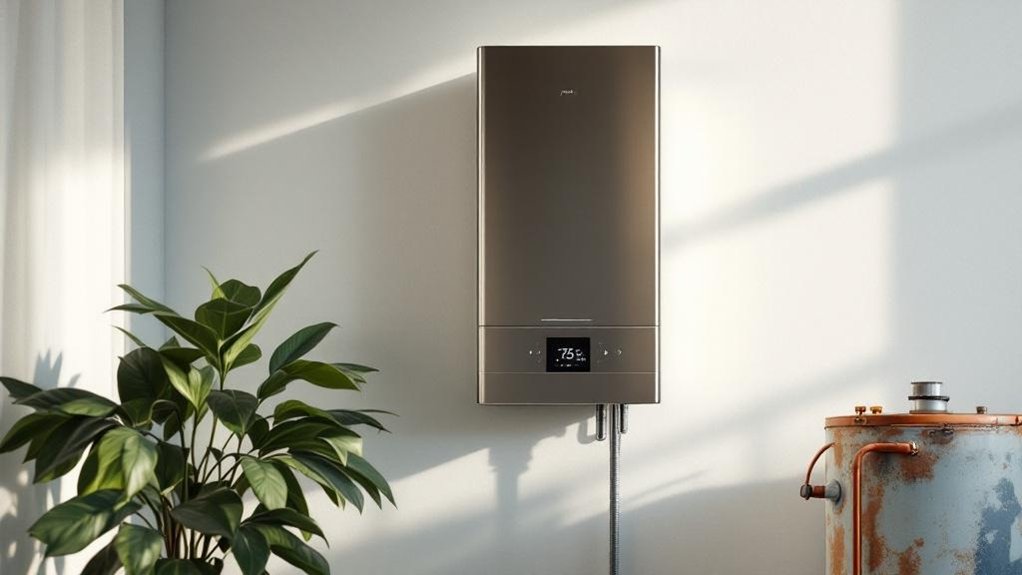
We’ve found that tankless water heaters substantially reduce carbon footprints by heating water only when needed, eliminating the energy waste associated with continuous tank heating. Their on-demand operation can achieve thermal efficiency ratings up to 99% for electric models, translating to meaningful energy conservation in daily household use. These efficiency improvements not only benefit the environment through reduced emissions but also result in tangible monthly utility savings for homeowners. Despite their efficiency benefits, tankless water heaters represent a relatively niche market segment, accounting for only about 12% of total water heater sales in the United States.
Reduced Carbon Footprint
Three critical environmental advantages make tankless water heaters an increasingly popular choice for eco-conscious homeowners. First, they achieve remarkable energy efficiency with electric models reaching 99% thermal efficiency—meaning minimal wasted energy compared to traditional systems.
Second, tankless systems greatly contribute to carbon reduction. With the U.S. averaging 17 metric tons of CO2 emissions per capita (compared to the global 5-ton average), these efficient units help lower your household’s carbon footprint significantly. These systems completely eliminate standby heat loss that occurs in conventional storage water heaters.
Finally, they represent a practical step toward sustainable living that we can all implement. As part of our community’s commitment to environmental responsibility, these systems deliver both immediate energy savings and long-term environmental benefits. By choosing tankless technology, we’re collectively reducing energy waste while maintaining the comfort and convenience we’ve come to expect.
On-Demand Energy Conservation
When considering the environmental impact of household appliances, tankless water heaters stand out with impressive energy conservation metrics that directly benefit both homeowners and the environment. These systems can be 8-14% more energy efficient for families with high water usage, potentially saving 37% on water heating energy costs.
The on-demand nature directly addresses energy demand challenges by heating water only when needed. Modern tankless units boast efficiency ratings from 82% for non-condensing models to even higher percentages for condensing versions. Over time, this translates to substantial savings of 48-61 therms annually for non-condensing models. Tankless water heaters also avoid the standby heat losses that plague traditional tank water heaters, further enhancing their efficiency profile.
We’re particularly impressed by the environmental benefits—over 30 years, new efficiency standards will reduce carbon dioxide emissions by approximately 32 million metric tons while improving air quality in our communities.
Maintenance Requirements for Optimal Performance
While tankless water heaters offer impressive efficiency and space-saving benefits, they require consistent maintenance to deliver peak performance throughout their lifespan.
We recommend establishing regular maintenance schedules that include annual professional servicing, especially for homes in hard water regions where bi-annual attention may be necessary. Filter cleaning should be performed every few months to prevent clogs and maintain ideal flow rates. Reasonably handy individuals can easily perform many maintenance tasks without professional assistance.
For ideal performance, always turn off power and close water valves before beginning any maintenance tasks. Remember to flush your system regularly to remove sediment buildup and descale as needed based on your water quality. Though some tasks are DIY-friendly, complex procedures like descaling often warrant professional assistance. The small investment in regular maintenance pays dividends through improved efficiency, extended equipment life, and reliable hot water when you need it.
Is a Tankless Water Heater Right for Your Home?
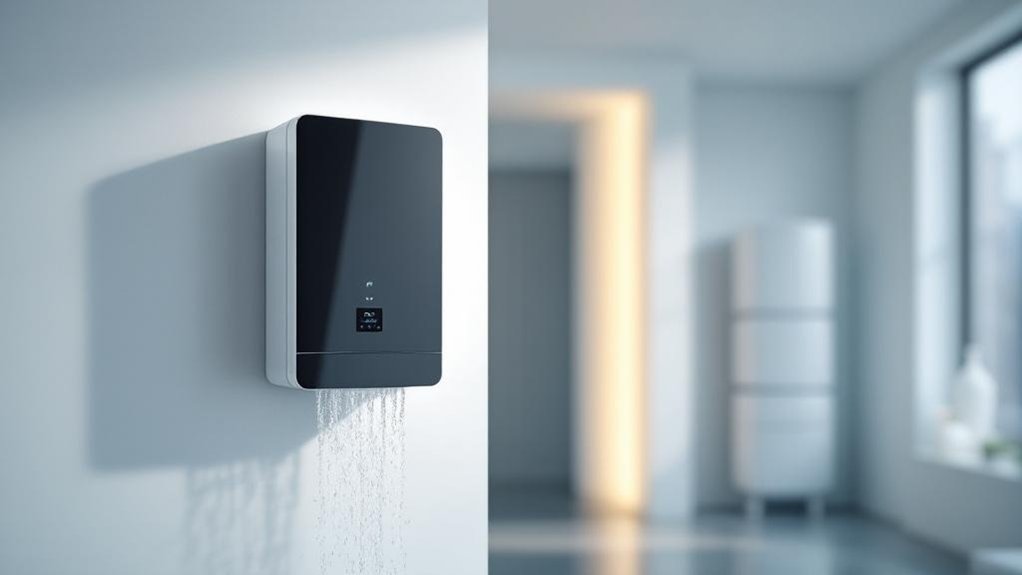
Deciding whether a tankless water heater is the right investment for your home requires careful consideration of several key factors. At Pride Electric, we evaluate your household’s unique water usage patterns, existing infrastructure, and budget constraints to determine suitability.
Based on extensive user feedback, homes with limited space often benefit most from tankless systems’ compact design. However, households with high simultaneous water demands might face limitations with standard units. User experience confirms that proper sizing is essential—we’ll assess whether your home needs a whole-house system or point-of-use installations.
We’ll also examine your current electrical capacity and water quality, as these factors greatly impact performance. While the initial investment is higher, long-term energy savings and continuous hot water supply make tankless systems ideal for many Canton homeowners. Customers who choose tankless options often qualify for incentives and rebates that can offset the upfront costs.
Frequently Asked Questions
How Noisy Are Tankless Water Heaters During Operation?
We find that tankless water heaters typically generate modest noise levels between 50-70 decibels during operation. You’ll notice operational sounds like water flow and heating elements activating, but they’re generally quiet performers.
Can Tankless Water Heaters Work During Power Outages?
No, most tankless water heaters won’t work during outages regardless of their power source or energy efficiency. We recommend installing a backup generator if you’re in an area prone to frequent blackouts.
Do Tankless Water Heaters Require Water Softeners in Hard Water Areas?
We strongly recommend water softeners for tankless heaters in hard water areas. Poor water quality accelerates mineral buildup, decreasing efficiency and lifespan. Regular maintenance is essential for peak performance regardless.
What’s the Typical Lifespan of Internal Components That May Need Replacement?
We see most internal components lasting 5-20 years, with heat exchangers at the longer end. Component longevity varies by water quality and maintenance. Replacement costs should be factored into your ownership planning.
Are There Specific Brands That Offer the Best Warranty Coverage?
In our warranty comparisons, we’ve found Noritz (25-year), EcoSmart (lifetime), and Bradford White (15-year) offer superior coverage. These brands demonstrate higher reliability while protecting your investment in ways our customers appreciate.
Conclusion
We’ve found that tankless water heaters offer significant energy savings and endless hot water for many Georgia homeowners, but they’re not ideal for every household. When evaluating your options, we’ll help you consider your home’s specific demands, installation requirements, and budget constraints. Whether you choose tankless or traditional, we’re committed to implementing the solution that delivers the best performance and value for your family’s needs.
